Most conversations about how to wear kente cloth for ladies start and end with draping tutorials. That misses the point almost entirely. Kente is a semiotic system before it is a garment — every strip width, color pairing, and pattern name carries meaning that was legible to its original wearers. Understanding that system does not make styling more complicated; it makes every choice more deliberate, which is exactly what separates informed dressing from costume.
The Strip-Weaving Architecture You Need to Understand First
Kente originates among the Asante and Ewe peoples of Ghana and Togo, and its defining structural feature is that it is never woven as a single piece of cloth. It is woven in narrow strips — typically between three and five inches wide — on a horizontal strip loom, then sewn selvage to selvage to create the finished textile. This is not a workaround or a historical accident; it is the technical foundation that gives kente its characteristic grid geometry and its near-infinite pattern variation.
The Asante tradition, centered in Kumasi, tends toward a balanced weave with strong geometric blocks and a silk or rayon ground. The Ewe tradition from the Volta region incorporates more figurative motifs woven directly into the weft — animals, tools, proverbs rendered in thread — and often uses a wider range of ground colors. When you are selecting a cloth, distinguishing between these two traditions matters stylistically: Asante kente reads as formally geometric and is conventional for high ceremony, while Ewe kente allows more narrative texture and is sometimes more adaptable to contemporary silhouettes.
As an Amazon Associate, I earn from qualifying purchases.
The strip seams are not a flaw to disguise. In a well-made cloth, the alignment of pattern across seams is intentional and technically demanding — misalignment signals either a lesser weave or a printed imitation. Printed kente, which reproduces the visual surface without the structural logic, is a separate category and carries none of the same occasion weight in Ghanaian social contexts.
💼 Career Opportunities
The Color Grammar: What Each Combination Communicates
Color in kente is not decorative in the Western sense — it is semantic. Individual colors carry associations that have been codified over centuries within Asante court culture, and while the system is not rigid across all communities, its broad outlines are stable enough to inform deliberate dressing.
Core Color Meanings
Gold and yellow are associated with royalty, wealth, and the authority of the Asante stool. A predominantly gold cloth is a statement of status and celebration — appropriate for weddings, outdoorings, and formal ceremonies, not for somber occasions.
Black in kente is more complex than its associations in Western dress. It carries spiritual depth, maturity, and the ancestors, but also intensification — a black ground reads as serious and weighty, not necessarily mournful. Black-dominant kente appears at funerals but equally at ceremonies where gravitas is appropriate.
Green speaks to growth, renewal, and the vitality of the earth — a color for new beginnings, which makes it appropriate for naming ceremonies and rites of passage.
Red signals sacrifice, political struggle, and strong emotion. It is powerful and not casually deployed in traditional contexts.
White is for purification, victory, and spiritual matters. Its inclusion in a cloth immediately elevates its ceremonial register.
Blue, particularly the deep indigo blue, relates to peacefulness and feminine energy in many Ghanaian readings.
In practice, kente cloths combine multiple colors, and it is the dominant ground plus the secondary accent colors that together establish the occasion register. A cloth with a gold ground, black accents, and green details says something quite different from one with a black ground and red supplementary weft patterns.
Pattern Names and What They Ask of the Wearer
Every authentic kente cloth has a name, and that name is not decorative labeling — it is the cloth's identity. Names reference proverbs, historical events, the names of chiefs or queens, or philosophical concepts. Oyokoman, one of the most recognized patterns, belongs to the Oyoko clan of the Asante royal family. Wearing a cloth whose name you know — and whose name is appropriate to your lineage or occasion — is the mark of someone who understands what they are carrying.
This does not mean non-Ghanaian or non-Asante wearers cannot dress in kente with integrity. It means that learning the name and general meaning of the cloth you are wearing is a minimum of respect — and for traditional wear at ceremonies where Ghanaian elders will be present, asking a knowledgeable vendor or the family hosting the event about appropriate patterns is never the wrong move.
Draping Styles for Women: Logic and Occasion
Women's kente draping differs significantly from men's — men typically drape a single large cloth toga-style over one shoulder, baring the right arm. Women's conventions involve more coverage and different cloth configurations, and the styles below reflect those conventions.
The Two-Piece Kaba and Slit
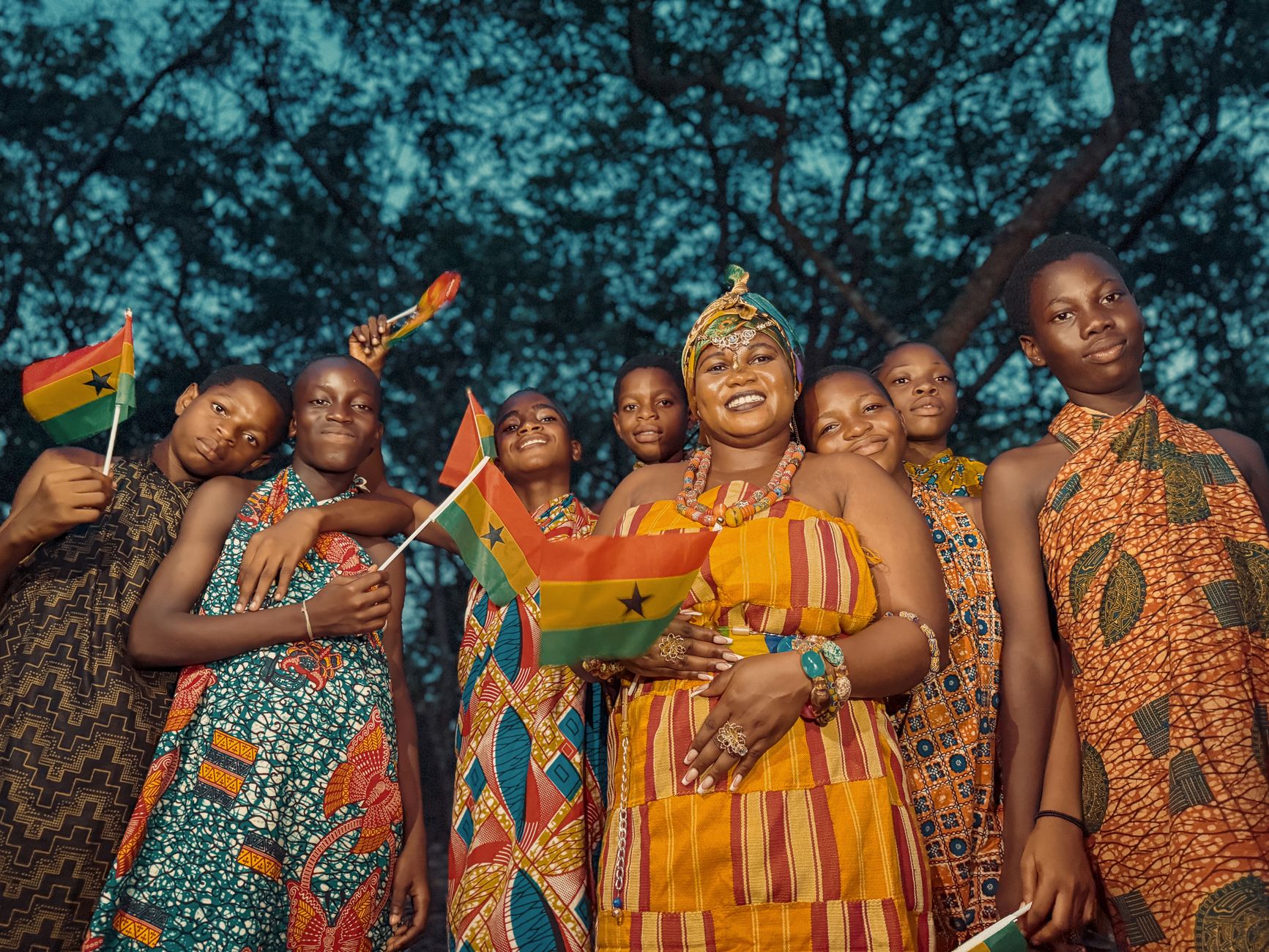
The most formal and widely recognized women's kente style involves having the cloth tailored into a fitted top (kaba) and a straight or slightly flared skirt (slit). The kaba follows the strip alignment of the cloth — a skilled tailor will plan the cut so that pattern blocks fall symmetrically across the bodice. The slit sits at the natural waist and falls to the floor or ankle for formal occasions. This silhouette is the baseline for Ghanaian weddings, church celebrations, and state functions.
The structural intelligence here: because kente strips run horizontally when worn, the pattern reads as a continuous band around the body. The tailor's job is to ensure the seams of the strips align across the side seams of the garment — if they do not, the cloth's internal geometry is broken.
The Wraparound Drape
A simpler and historically older style wraps the cloth around the body and secures it at the shoulder or chest. For women, this often involves a secondary piece — a shorter cloth wrapped over the main drape, or one cloth wrapped sarong-style and a second used as a shoulder or chest wrap. The key proportion rule: the cloth should be long enough to allow a clean wrap without pulling at the hip or gapping at the chest. A standard women's kente cloth for draping runs approximately six yards.
This style is appropriate for outdoor ceremonies, festivals, and occasions where movement matters. It is more forgiving of body variation than the tailored kaba and slit, and the draping can be adjusted in real time.
Contemporary Cuts for Modern Contexts
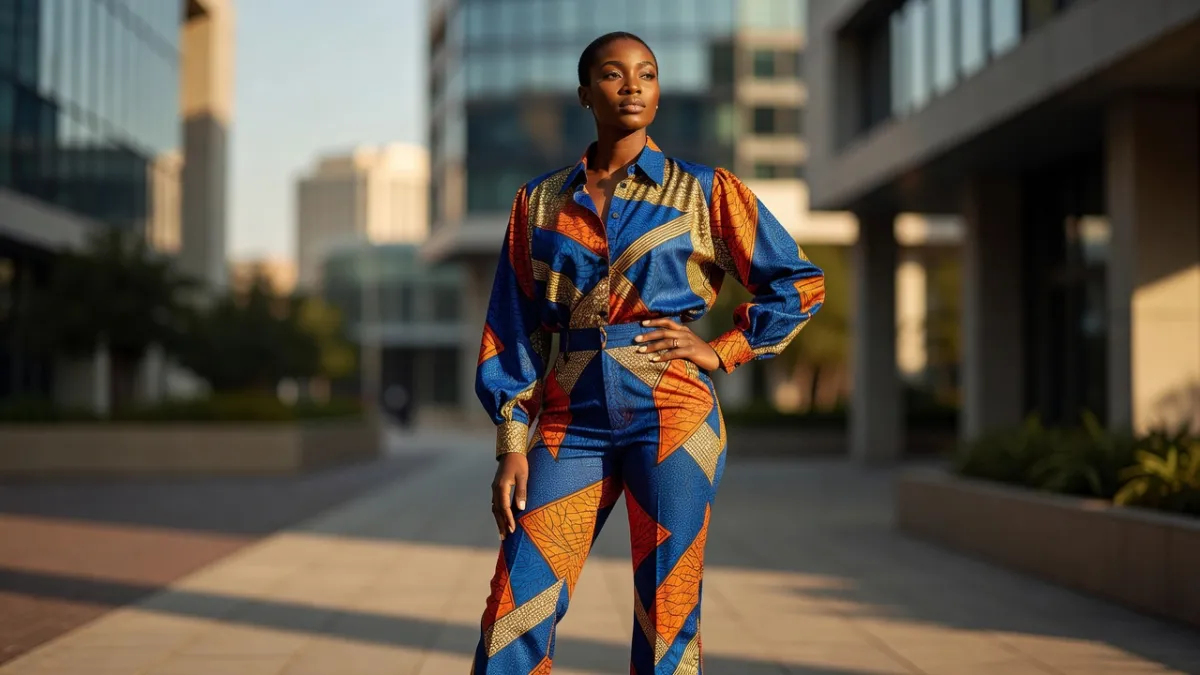
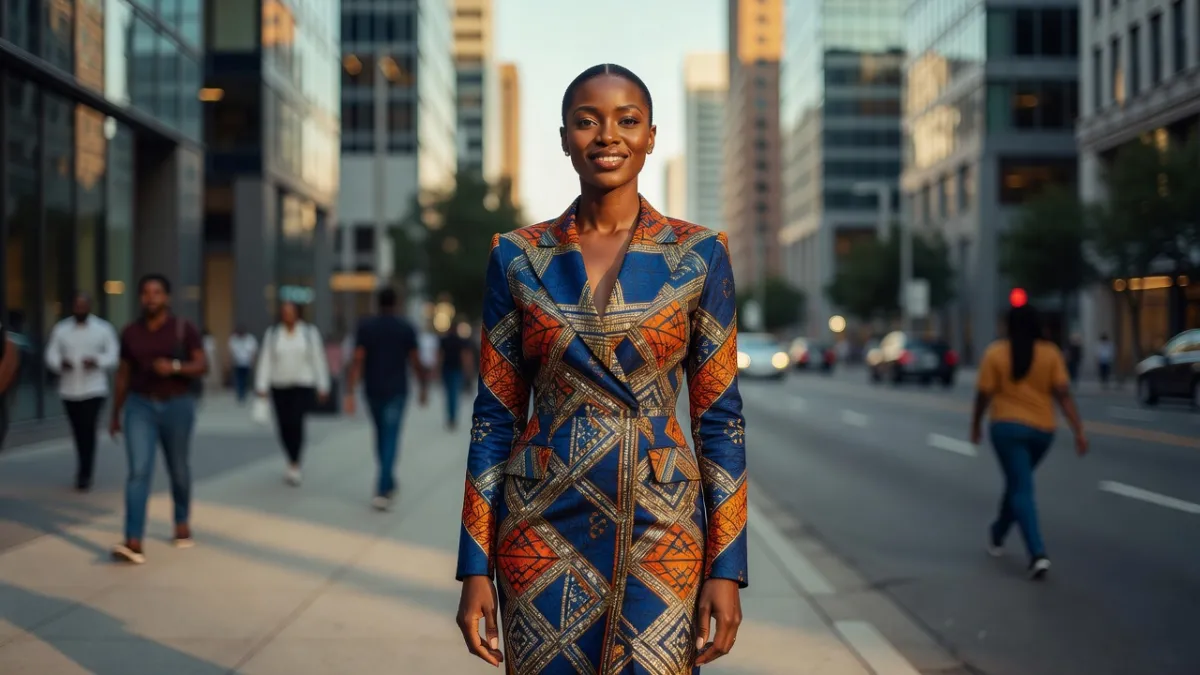
Design graduates working with kente need to reckon honestly with the tension between the cloth's ceremonial weight and the reality that contemporary modern African style has made kente-incorporated garments — blazers, midi dresses, corset tops — part of everyday fashion vocabulary globally. The distinction that matters here is how much of the cloth's structural logic is preserved. A kente-panel blazer that treats the strips as decorative trim loses the semantic system entirely. A structured coat cut from a full kente cloth, maintaining strip alignment and honoring the cloth's color relationships, is a different conversation.
For occasion dressing, the rule of thumb is proportional: the more ceremonial the event, the more the cloth should remain in its traditional register. A contemporary kente wrap dress at a cultural festival reads differently than the same dress at a royal naming ceremony where full kaba and slit is the community expectation.
Accessorizing Without Competing with the Cloth
Kente is visually dense. Its color saturation and geometric complexity mean that accessories must be chosen to support rather than compete. Gold jewelry is the conventional pairing — it reinforces the gold ground colors present in most Asante kente and echoes the cloth's association with wealth and ceremony. Beaded jewelry in complementary earth tones works for Ewe kente, which often has a more varied palette.
Headwraps in kente or in a coordinating solid are standard for formal occasions. The wrap style itself — how high, how architectural — communicates formality level. A flat, neat wrap reads as contained and appropriate for daytime ceremony. A sculptural, high wrap commands presence at evening events.
Shoes should not pull focus. Nude, gold, or tonal leather heels are the traditional choice. Highly embellished footwear fights with the cloth's own pattern density.
Reading the Room: Occasion Calibration
Kente is specifically a cloth for celebration and ceremony — it was historically reserved for Asante royalty and worn only on significant occasions. That origin is not irrelevant to modern styling choices. Wearing a full kente cloth to a casual gathering in a context where its ceremonial weight is understood reads as overdressed in the same way that arriving at an informal lunch in full court regalia would. Conversely, wearing a kente-panel detail garment to a formal Ghanaian state ceremony would be read as a failure to honor the occasion.
The calibration questions to ask before dressing: Who is hosting and what is the community's expectation? Is this a Ghanaian or broader diasporic ceremony where kente's codes will be actively read? What occasion register does the cloth's color combination establish? Answering these three questions honestly will resolve most styling decisions more reliably than any general rule about hemlines or necklines.
On Imitation Fabrics and Structural Integrity
The market is saturated with printed kente — polyester and cotton fabrics printed to mimic kente's visual surface. For fashion designers and style professionals, the distinction is technical as well as cultural. Printed kente has no warp-float structure, no supplementary weft patterning, and no strip-seam construction. It can be used in contemporary design work as a print reference, but it should not be presented as kente cloth, and in ceremonial contexts it is not an equivalent substitution. Authentic handwoven kente from Ghanaian weavers — particularly from Bonwire, the historic center of Asante kente weaving — is a different textile category entirely, and should be named and treated as such.