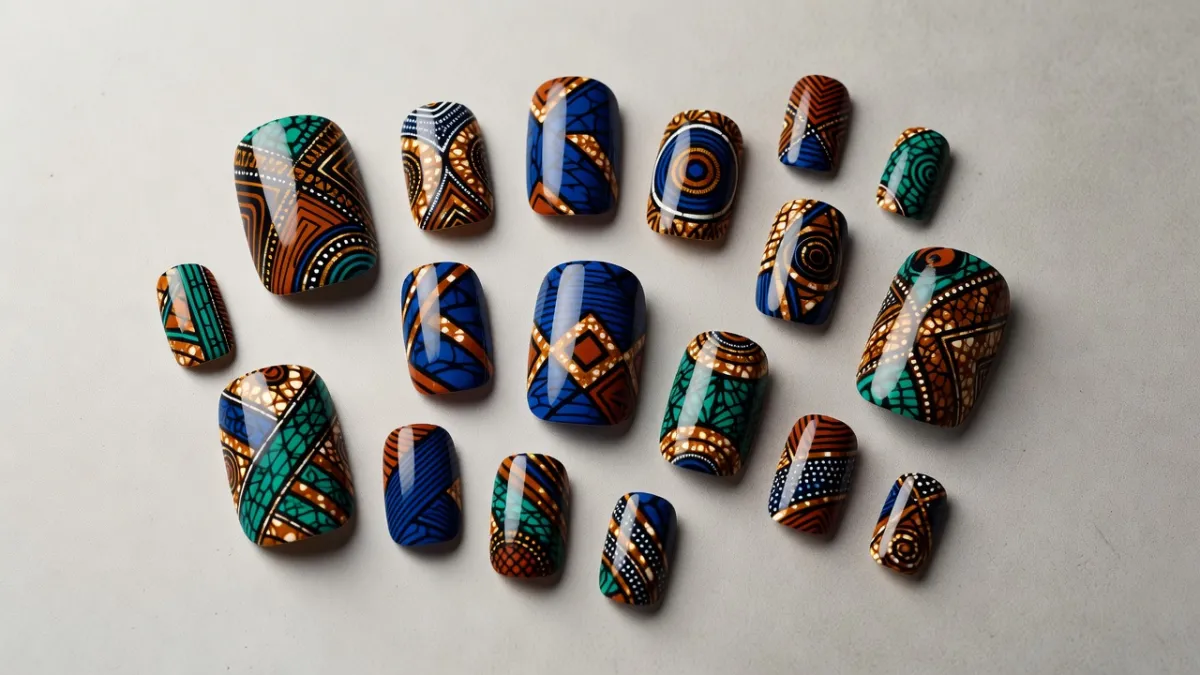
Every fold of cassava-starched cloth, every tied bundle, every wax-drawn line in adire textile work is a decision weighted with meaning. This is not decorative abstraction — it is a visual language with grammar, vocabulary, and provenance. As Nigerian designers increasingly position adire at the centre of contemporary collections shown in Lagos, London, and New York, understanding that language has become both a creative and ethical imperative. The renaissance is real, it is documented, and it is complicated.
What Adire Actually Is — Beyond the Indigo Aesthetic
The word adire translates roughly from Yoruba as "cloth that is tied and dyed," but this etymology only captures one of the tradition's primary resist techniques. In practice, adire encompasses at least three distinct methods of resist application, each producing different surface qualities and each associated with different pattern vocabularies.
Adire eleko uses cassava starch paste applied to cloth with a feather or metal comb to block dye penetration. Adire oniko uses tying, folding, and stitching — closer to what the global market loosely calls shibori or tie-dye, though adire oniko predates the Western popularisation of either term. Adire alabere employs a needle and thread to gather fabric before dyeing, creating precise geometric patterns on release.
Adire is a Yoruba textile tradition originating in southwestern Nigeria that uses resist-dyeing techniques, primarily with indigo, to create patterned cloth with names dating back at least to the early 20th century. That phrase "names dating back" is critical: adire is not simply a dyeing process. It is a catalogued system of named designs, each with specific application rules, visual identifiers, and often explicit cultural or spiritual referents.
The Geography of Production: Abeokuta and Its Guilds
To understand the tradition's current revival, you need to understand where the knowledge was concentrated and how it was almost lost. The town of Abeokuta in Ogun State, Nigeria, is historically documented as a major center of adire production, with women dyers' guilds that controlled the craft through much of the 20th century.
💼 Career Opportunities
These guilds were not informal collectives. They were structured organisations that regulated pattern ownership, apprenticeship terms, and the transmission of technique from master dyer to trainee. The guild system meant that specific pattern families were associated with specific lineages of practitioners — a design's genealogy was as traceable as a garment maker's signature.
The erosion of this system accelerated from the mid-twentieth century onward, driven by a confluence of factors: the introduction of synthetic indigo substitutes that democratised access but diluted craft standards; the flood of machine-printed imitations of adire patterns that looked superficially similar but carried none of the material intelligence; and the broader economic disruptions that made the long apprenticeship model increasingly difficult to sustain. By the late twentieth century, the number of practitioners working in the eleko technique in particular had contracted sharply, and with them went granular knowledge of the rarer named pattern variants.
The Pattern Lexicon: Reading What the Cloth Says
This is where adire diverges most sharply from the way Western fashion discourse tends to treat African textiles — as visual raw material rather than as encoded communication. The named patterns are not merely decorative categories. They are references: to geography, to cosmology, to social events, to specific Yoruba deities and their domains.
Specific adire patterns carry distinct Yoruba names and associated meanings — for example, 'Ibadandun' references the city of Ibadan and 'Olokun' references the Yoruba deity of the sea. Olokun, the orisha associated with the deep ocean, wealth, and the unconscious, appears in adire compositions that use flowing, unpredictable marks — visually evoking the movement of water in ways that are structurally deliberate rather than accidental. A practitioner trained in the tradition recognises the reference immediately; an untrained eye sees beautiful abstraction.
Other named patterns reference domestic objects, proverbs, historical events, and astronomical phenomena. Some patterns were considered appropriate for specific social occasions — mourning, celebration, initiation — while others indexed the wearer's social status or regional identity. The cloth functioned, in other words, as both textile and text.
The Problem of Pattern Orphaning
When practitioners die without transmitting the full semantic weight of a pattern — its name, its correct compositional rules, its appropriate context of use — what remains is visual form stripped of meaning. This is what researchers and revival-oriented designers are calling "pattern orphaning": the survival of an aesthetic signature without its cultural content. It is one of the central challenges facing anyone working seriously in this space.
The Contemporary Revival: Who Is Doing What
The current renaissance in adire is not a single movement. It comprises several overlapping but distinct projects, sometimes in productive tension with each other.
Documentation and Research
A first wave of serious contemporary engagement with adire has come from textile researchers, museum curators, and cultural historians working to catalogue surviving pattern names, interview elder practitioners, and create records before knowledge is lost entirely. Institutions in Nigeria and in diaspora contexts have invested in this archival work. For designers, these archives are becoming primary source material in the most literal sense — returning to documented pattern names and their associated meanings rather than working from generalised aesthetic impression.
Designer-Practitioner Collaboration Models
Several Lagos-based and diaspora Nigerian designers have developed working models that centre collaboration with trained adire practitioners rather than simply commissioning fabric in bulk. The distinction matters technically and ethically. When a designer works directly with a dyer fluent in the named pattern system, there is a feedback loop: the designer's contemporary silhouette or construction intention can be communicated to the practitioner, who can then select or adapt a pattern appropriate not just visually but semantically.
This requires designers to build vocabulary. Pattern names, the orisha and cultural referents they invoke, the compositional logic of eleko versus oniko — these are not optional context for the designer working seriously with adire. They are the grammar of the material they are using.
The Synthetic Indigo Question
One of the more technically contested debates in the revival concerns the use of natural versus synthetic indigo. Historically, Yoruba dyers used elu — indigo derived from Lonchocarpus cyanescens, the West African wild indigo plant — fermented in large clay pots to create the alkaline dye bath required for the reduction process. The resulting colour has a specific quality: a surface bloom, an unevenness of penetration that interacts differently with resist marks than synthetic indigo does.
Synthetic indigo is chemically identical to natural indigo in its core chromophore, but the fermentation environment of a traditional elu dye pot introduces variables — bacterial activity, organic matter, mineral content of local water — that affect the final cloth in ways that are difficult to fully replicate industrially. For designers working with adire as cultural practice rather than aesthetic gesture, the choice of dyestuff is not incidental. It is part of the work's integrity.
Global Fashion and the Risk of Flattening
The international appetite for adire has intensified markedly in the past decade. This creates both opportunity and risk for the tradition. The risk is not simply commercial appropriation in the abstract — it is the specific flattening that happens when a pattern system with dozens of named variants, each carrying distinct cultural weight, gets reduced to "indigo abstract print" in the visual grammar of global trend forecasting.
When a pattern is reproduced without its name, without knowledge of its referent, and without the resist-dyeing process that gives it material identity, something fundamental has been discarded. The challenge for designers working at the intersection of adire and international markets is to find formats — in collection notes, in how they speak to press, in their own visual communication — that preserve the specificity of what they are working with.
Some practitioners have been explicit that certain patterns should not circulate outside specific ceremonial contexts regardless of commercial interest. These are not abstract claims to ownership but specific arguments about appropriate use that the tradition itself encodes. Designers with formal training are better equipped to understand and engage with these distinctions than to simply override them in pursuit of a striking visual.
Technical Considerations for Working Designers
For graduates and professionals looking to engage with adire at a serious technical level, several practical points are worth foregrounding.
Cloth Preparation and Fibre Behaviour
Traditional adire is worked on cotton — typically a plain-weave cotton that has been krenked (beaten against a stone) to increase its receptivity to starch paste and dye. The mechanical preparation of the cloth affects dye uptake in ways analogous to how sizing and finishing affect discharge printing. Designers experimenting with adire techniques on alternative substrates — silk habotai, linen, bast fibre blends — need to account for how fibre porosity and surface texture will alter both the resist behaviour and the final colour quality.
Starch Paste Viscosity in Eleko Work
In adire eleko, the viscosity and drying behaviour of the cassava starch paste is the primary technical variable controlling pattern definition. Too thin, and the paste spreads beyond the intended mark; too thick, and it cracks during drying before the cloth is immersed, creating inadvertent texture that may or may not be desirable. Traditional practitioners calibrate this through accumulated material knowledge and environmental awareness — humidity, temperature, and the specific cassava preparation all factor in. Designers attempting eleko in unfamiliar climates often find that the paste behaves differently than in the humid conditions of southwestern Nigeria, requiring adjustment rather than simple recipe replication.
The Dye Bath and Oxidation Cycle
Indigo does not bond to fibre while dissolved in solution — it bonds during oxidation, as the reduced leuco-indigo form reoxidises on the cloth surface when exposed to air. This means that the number of immersion-and-oxidation cycles directly determines depth of colour, and that the dyer's control of timing between immersions is as significant a craft variable as the dye concentration itself. For pattern clarity in resist work, the mechanical action of immersion must be controlled carefully to prevent resist materials from shifting or releasing prematurely.
Why This Matters Beyond Cultural Preservation
The adire revival is sometimes framed primarily as a cultural heritage project — important but implicitly separate from the forward momentum of contemporary fashion. This framing underestimates what is at stake technically and aesthetically.
The named pattern systems of adire represent a resolved design tradition: a vocabulary in which visual decisions are non-arbitrary, in which composition carries semantic content, and in which material process and cultural meaning are integrated rather than parallel. For designers working in an era when fashion is under significant pressure to articulate why its choices matter beyond trend, a tradition that has encoded "why" into its grammar for over a century has something precise and practical to offer.
The work of decoding, preserving, and thoughtfully extending that tradition is not nostalgic. It is technically demanding, culturally serious, and formally sophisticated — exactly the kind of problem that rewards the depth of training that fashion design education, at its best, is supposed to produce.
Sources
Every factual claim in this article was independently verified against the following sources:
- Adire Cloth of the Yorubas - Adire African Textiles — adireafricantextiles.com
- Adire (textile art) - Wikipedia — en.wikipedia.org
- Identification-and-Categorization-of-Adire-Symbols-Among ... — maidjad.com