Most textile traditions encode meaning through surface — through print, dye, or embroidery applied after the cloth is made. West African strip weaving is fundamentally different. Here, meaning is structural: it is decided on the loom, woven into the geometry of interlacement, and then compounded through the deliberate act of assembly. By the time a finished cloth reaches a wearer, it has already passed through a sequence of decisions — technical, social, symbolic — that no post-production finish can replicate. Understanding how the system works is essential for any designer or textile professional who wants to engage with these traditions honestly rather than superficially.
The Mechanics of the Narrow Loom
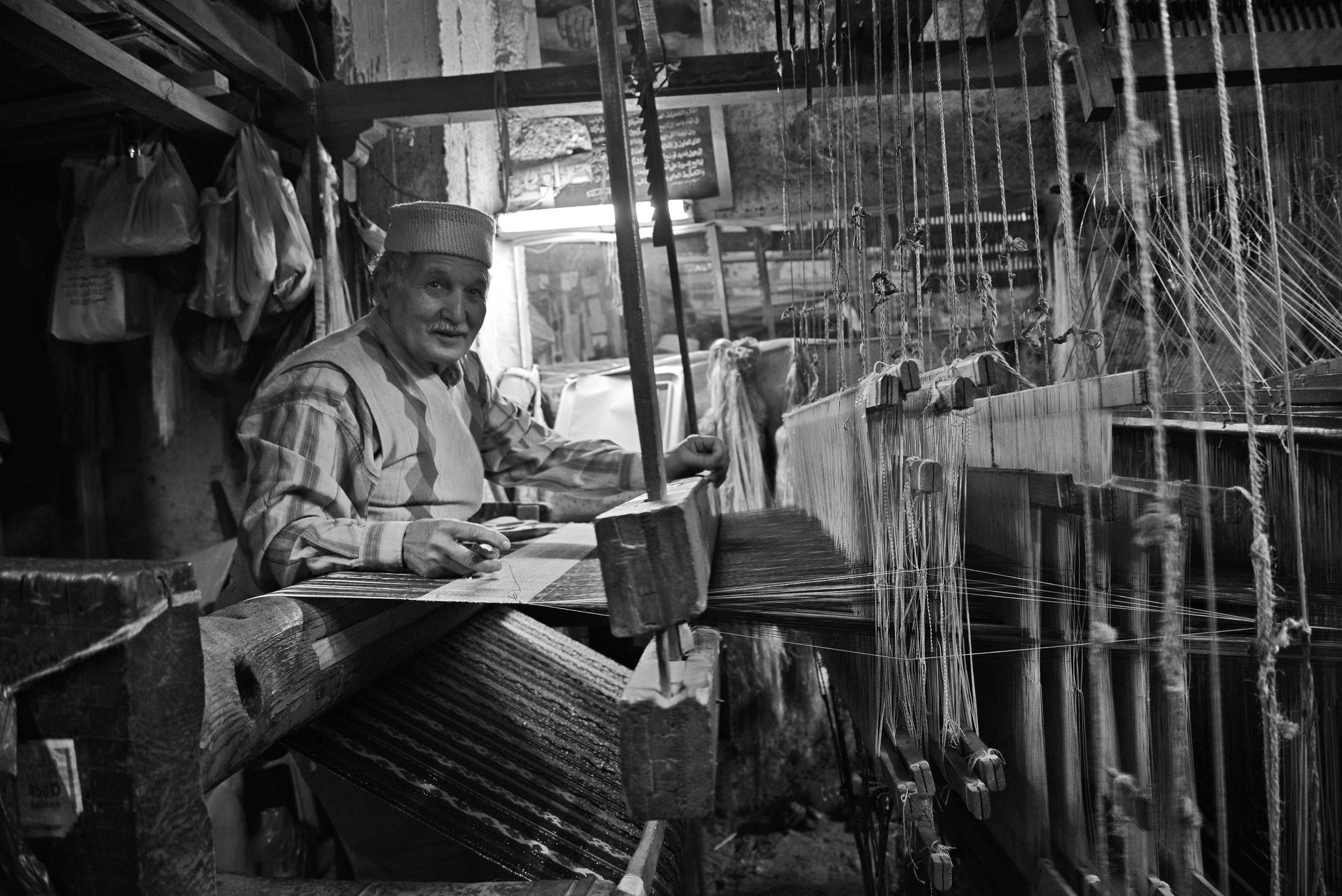
Strip weaving across West Africa — practiced by the Asante and Ewe of Ghana, the Yoruba of Nigeria, the Mandé-speaking peoples of Mali and Guinea, the Wolof of Senegal, and numerous other groups — is executed on a horizontal, ground-level treadle loom that produces a band of cloth typically between three and five inches wide. The loom itself is deceptively simple in profile: two sets of heddles, controlled by foot pedals, lift alternating warp threads to create a shed through which the shuttle passes. What makes it sophisticated is not the machine but the system of decisions the weaver must make before a single thread is thrown.
The warp is set up at considerable length — sometimes stretching thirty or forty feet — anchored to a weighted drag at the far end that maintains tension as the weaver advances the cloth. This long warp is fundamental. It allows the weaver to plan a repeating sequence of pattern blocks across the full length of the strip, so that when strips are eventually sewn together edge to edge, the blocks either align precisely or offset in a predetermined rhythm. This is not incidental. It is engineering.
As an Amazon Associate, I earn from qualifying purchases.
Warp-Faced and Weft-Faced Zones
One of the most technically distinctive features of West African strip weaving — particularly in Asante kente and Ewe kente — is the combination of warp-faced and weft-faced weave structures within a single strip. In warp-faced sections, the warp threads dominate the visible surface, producing the crisp vertical stripes that characterize the ground cloth. In weft-faced inlay sections, supplementary weft threads float across the surface to build figurative or geometric motifs, completely obscuring the warp. The weaver switches between these two modes within a single piece, controlling which threads are lifted and which suppressed with each shed change.
💼 Career Opportunities
This dual-structure approach means the cloth is simultaneously two things: a striped textile and a pictorial or symbolic one. The stripe is not a background on which pattern sits — it is an equal participant in the overall composition. When strips are sewn together, the vertical stripes in the warp-faced ground create a grid across the assembled cloth, and the weft-faced motifs appear like windows cut into that grid. The relationship between the two registers — stripe and motif, order and interruption — is the essential aesthetic and communicative language of the cloth.
Assembly as Composition: The Sewn Seam Is Not a Seam
Fashion training tends to regard the seam as a join — a place where two pieces of fabric meet and are hidden. In strip-woven cloth, the join is a compositional element. When a Ghanaian tailor or weaver-assembler sews strips of kente together with a needle and thread, using a tight whip stitch along the selvages, the resulting seam line becomes a visual feature of the cloth's surface. The selvages of individually woven strips are clean and firm — no fraying, no finishing required — and the seam between them reads as a deliberate line in the overall grid.
More importantly, the assembly sequence determines the final pattern. Strips can be laid down in order, inverted, offset by a half-repeat, or selectively arranged so that certain weft-faced motifs cluster at the center or the borders of the assembled cloth. A weaver who has planned the warp sequence carefully has, in effect, pre-programmed a range of possible assembled compositions. The assembly is therefore not a secondary operation — it is the completion of a design system that was initiated on the loom. Designers working with traditional wear who source finished kente or strip-woven cloth without understanding this logic often misread the cloth's internal order, making cuts that sever the compositional logic the weaver encoded.
As an Amazon Associate, we earn from qualifying purchases.
Kente as a Case Study in Structural Symbolism
Kente — the royal cloth of the Asante — is the most internationally recognized product of West African strip weaving, and it illustrates the structural dimension of meaning most clearly. Each named kente pattern constitutes a specific warp-color sequence combined with a specific arrangement of weft-inlay motifs. The name of a cloth does not simply describe how it looks; it references the occasion for which it is appropriate, the social rank of its intended wearer, or a historical or proverbial reference embedded in the design.
The pattern called Oyokoman, associated with the Oyoko clan — the royal lineage of the Asante — uses a specific chromatic arrangement that is understood to carry that clan's identity. Wearing a cloth is therefore not simply a matter of aesthetics; it is a declarative act. The structural encoding means the declaration is present whether or not any observer can read it, because it exists in the weave itself, not in a label or a tag.
Ewe Kente and the Pictorial Register
Ewe kente, produced by the Ewe people primarily in the Volta Region of Ghana and in Togo, extends the weft-inlay tradition into a more explicitly pictorial mode than Asante kente. Ewe weavers incorporate representational imagery — animals, human figures, tools, celestial motifs — alongside abstract geometric forms, all within the weft-faced inlay sections of the strip. This pictorial capacity means that Ewe cloth can carry narrative as well as symbolic content: a specific cloth might depict proverbs, historical events, or personal biography.
From a technical standpoint, this pictorial work requires the weaver to manipulate supplementary weft threads across controlled groups of warp ends, building the image row by row. The weaver works largely from memory and internalized pattern knowledge — there is no cartoon pinned beneath the warp, no graph paper draft clipped to the loom. The design exists first in the weaver's understanding of the system, then in the cloth.
Aso Oke and the Yoruba Strip Tradition
In southwestern Nigeria, the Yoruba strip-weaving tradition produces aso oke — literally "top cloth" or "prestige cloth" — on a narrow horizontal loom that operates on broadly similar principles to the Ghanaian kente loom, though the resulting aesthetic is distinct. Aso oke is characterized by a looser, more open weave structure than kente, often incorporating supplementary weft floats (called sanyan, alaari, or ètù, terms that originally referred to the fiber type — wild silk, red-dyed silk, and indigo-dyed cotton respectively) that create a textured, lustrous surface.
The strip width in aso oke is often slightly wider than kente strips, and the assembled cloth — typically used for headties, wrappers, and agbada fabric — has a different compositional logic. Where kente's warp stripes create a strong vertical rhythm in the assembled cloth, aso oke's dominant visual feature is often the horizontal weft float, which runs across the full width of each strip and, when assembled, creates a continuous horizontal register across the cloth's surface. The directionality of the textile's compositional logic is literally reversed between the two traditions — and both are coherent, internally consistent systems.
The Bogolan Parallel: When Resist and Strip Logic Diverge
It is worth briefly distinguishing strip weaving from another major West African textile tradition — bogolan (mudcloth) from Mali — because the two are sometimes conflated in international design contexts. Bogolan is also woven in strips and assembled, but its meaning system operates primarily through the resist-dye and fermented mud application that gives the assembled cloth its surface patterns. The strip structure in bogolan is the substrate, not the message carrier. In kente and aso oke, the strip structure itself — the sequence of warp colors, the placement of weft inlays — is inseparable from the meaning. This is the distinction that matters for a designer: substrate versus system.
Why Width Constraints Generate Complexity
The narrow loom's constraint is productive. Because each strip is only a few inches wide, the weaver cannot rely on the expanse of cloth to create pattern — every compositional effect must be achieved within a tight horizontal band and then multiplied through assembly. This forces a kind of modular thinking that has direct parallels to parametric design: you define a unit, you define the rules for combining units, and the system generates complexity from simplicity.
The strip is, in information-design terms, a module. Its warp-color sequence is the base parameter. Its weft-inlay arrangements are conditional operators — they fire at specific points in the warp sequence, introducing variation within the established grid. The assembled cloth is the output of running those parameters across multiple instances. A design professional who understands parametric or modular design systems will find the logic of strip weaving immediately legible — it is the same logic, arrived at through a different technology and embedded in a different cultural context.
Implications for Contemporary Design Practice
For fashion designers working with or responding to West African strip-woven textiles, the structural argument has concrete implications. Cutting across the strip seams dissolves the compositional system — it produces fragments of pattern without the relational logic that gives the pattern coherence. Treating strip-woven cloth as equivalent to a printed fabric (where the print can be placed anywhere on the cloth's surface) misunderstands the textile at a technical level.
Designers who engage seriously with this tradition tend to work with the strip orientation rather than against it — allowing the vertical or horizontal register of the assembled cloth to inform silhouette and seam placement, rather than imposing an external silhouette on the cloth regardless of its internal architecture. There is also a growing body of contemporary African designers who are reinterpreting strip-weaving logic through new materials and scales, producing work that is in genuine dialogue with the tradition rather than simply sampling it visually. This is relevant territory for anyone working in modern African style, where the conversation between heritage textile systems and contemporary design practice is increasingly sophisticated.
Reading the Cloth
The phrase "the strip is the message" is not rhetorical flourish. In West African narrow-loom weaving, the strip is the unit of meaning-making, the module of the compositional system, and the physical record of the weaver's decisions. Meaning does not sit on top of the cloth — it is the cloth, structured into the interlacement of warp and weft and compounded through the intelligence of assembly. For textile professionals trained in European weaving traditions, where the dobby or jacquard loom expanded cloth width to allow pattern to unfurl across a broad field, the West African strip tradition offers a genuinely different model: constraint as generative force, the module as the message, and the seam as composition rather than closure.
That is what makes these textiles worth understanding technically, not just appreciating aesthetically. The sophistication is in the system.