In most portrait traditions, the ground is neutral — canvas, paper, or panel functioning as an inert support for the image built upon it. Bahamian textile artist Gio Swaby collapses that hierarchy entirely, using freehand machine embroidery on sheer or transparent fabric to depict Black women in works where the ground is simultaneously visible, structural, and meaning-laden. The fabric does not disappear behind the image. It is the image. For designers and visual practitioners trained to think carefully about materiality, Swaby's approach offers a genuinely instructive study in how technique and concept can become inseparable.
The Technical Foundation: Freehand Machine Embroidery on Sheer Ground
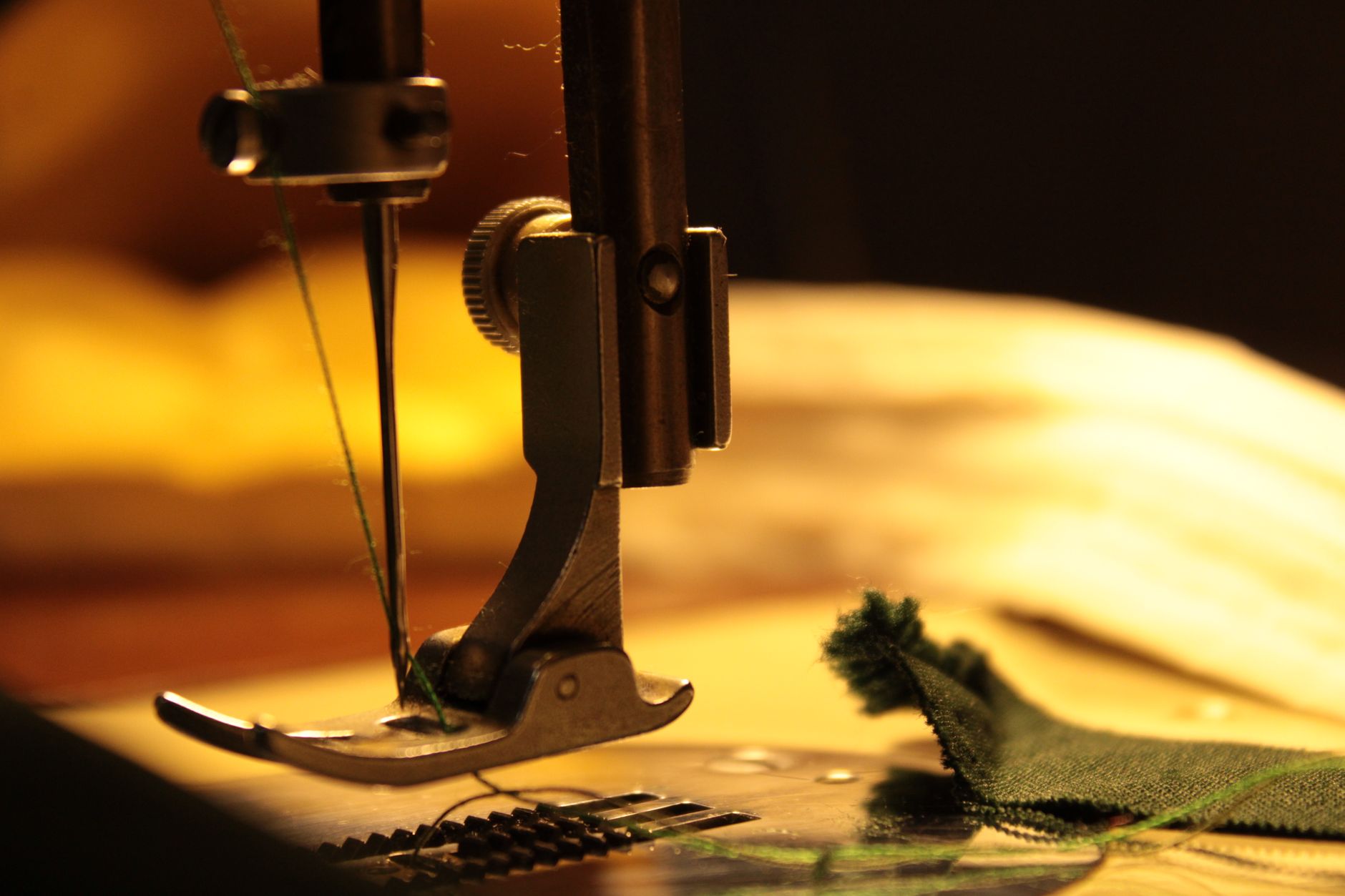
Freehand machine embroidery — sometimes called free-motion embroidery — involves disengaging or lowering the feed dogs on a domestic or industrial sewing machine, which removes the mechanism that would otherwise advance the fabric at a regulated pace. With feed dogs dropped, the embroiderer becomes fully responsible for moving the fabric in any direction, at any speed, beneath a fixed needle. The result is a drawing instrument: the needle traces whatever path the hands guide, producing lines of thread that function more like mark-making than conventional stitching.
Swaby works at scale, which immediately amplifies the demands of this method. Maintaining compositional coherence across a large piece of sheer fabric — without the structural security of a dense woven ground — requires a highly developed spatial intelligence. The transparency of the fabric means every pass of thread is visible from both sides, and the negative space between stitch lines is not blank so much as active: it holds the silhouette, describes the skin, and allows the wall behind the work to become part of the image when installed.
Why Sheer Fabric Changes Everything
The choice of a transparent or semi-transparent ground is not incidental. In conventional embroidery or tapestry, fabric provides opacity — the image sits on top of a concealing surface. On sheer ground, the logic reverses. The body of the subject is not painted or filled in; it exists as absence, legible only through the thread lines that define its edges and contours. The figure is present because of what surrounds and describes it, not because it has been rendered solid.
For a body of work concerned with the visibility of Black women — historically subject to erasure, misrepresentation, or hypervisibility on others' terms — this is a precise formal argument. The Black female body in Swaby's portraits is not filled with colour or pattern by an external hand. It holds its own space. The thread traces it; the fabric allows it to breathe. The viewer must do some of the constructive work, and that act of looking becomes participatory rather than passive.
The Politics of the Unfinished Line
Swaby's surfaces frequently include thread ends left trailing, visible starting and stopping points, and lines that do not resolve into clean outlines. To a viewer conditioned by fine craft traditions — where finishing means concealing process — this reads as deliberate refusal. In the context of textile work, which has long been categorised as craft rather than fine art, and which has been feminised and consequently devalued within that hierarchy, leaving the process visible is a double gesture: it asserts the validity of the medium and declines to smooth over the labour that produced the object.
This connects to a longer conversation in textile art about what 'finish' means and whose standards it reflects. The insistence on invisible technique in haute couture, for instance, serves a specific ideology of effortlessness — the idea that skill should erase itself. Swaby's visible process works against that ideology. The stitch is the testimony; hiding it would be a kind of dishonesty about how the work came to exist.
Imperfection as Information
Free-motion embroidery at scale cannot be geometrically precise in the way that digitally controlled machine embroidery can. Lines wobble slightly. Density varies. These micro-variations are not errors to be corrected but signatures of a hand moving in real time through a considered act. For portrait work specifically, this has expressive consequences: the slight irregularity of a stitched line describing a shoulder or jawline carries a quality of attention that a mechanically perfect outline cannot replicate. It reads as drawn rather than plotted, and drawing implies presence — someone was here, making this, deciding in the moment how the line should move.
Fashion design graduates will recognise this tension from pattern-making and toile work, where the hand-drawn line on calico carries a different authority than its digitised counterpart — not because it is more accurate, but because it records decision-making. Swaby's stitched lines operate on the same logic at a different scale and with a different subject.
Fresh Up and Institutional Context
Swaby's series Fresh Up was exhibited at the Art Institute of Chicago, one of the first major U.S. museum solo presentations of her work. The institutional context matters here beyond the biographical. The Art Institute holds one of the significant collections of decorative arts and textiles in North America, and situating Swaby's work in that context implicitly stages a conversation about the category distinctions that have historically separated textile practice from fine art. A large-scale portrait in thread and sheer fabric, hung in a major encyclopedic museum, asks visitors to apply the same interpretive seriousness they would bring to oil on canvas — and asks the institution to validate that request.
Fresh Up as a title is worth reading closely. 'Fresh up' is a Caribbean English expression for the act of getting dressed, grooming, presenting oneself — the daily ritual of self-construction and self-presentation. The series depicts Black women and girls engaged in exactly these acts: braiding hair, adjusting clothing, looking at themselves. The subjects are shown in states of intentional self-fashioning, which maps directly onto the formal strategy: the works themselves are acts of self-fashioning, made by a Black woman artist choosing how Black women will be depicted and in what material language.
Compositional Strategy: What Thread Can and Cannot Do
Swaby's compositional decisions reflect a precise understanding of thread's properties as a drawing medium. Line weight is controlled by thread count and pass density rather than pressure — to thicken a line, you stitch over it multiple times. Value shifts are created through hatching and cross-hatching in thread, which means the tonal range is built from line decisions rather than wash or fill. Colour in areas of detail — clothing patterns, hair accessories — tends to be denser and more opaque than the lines describing skin, reinforcing the formal argument about how the body is held within the composition.
The relationship between figure and garment is particularly charged. Where the clothing is depicted with pattern and colour in thread, it has visual weight and specificity. The figure wearing it is described more lightly, present through contour. This is an inversion of conventional portrait hierarchies, in which the face typically carries the most detail and the clothing exists as context. In Swaby's work, the clothes — often patterned, culturally specific, chosen — are given their full weight as expressions of identity, not subordinated to physiognomy.
Scale as Insistence
Working at large scale with a technique associated with domestic craft — embroidery hoops, sewing machines, the domestic interior — is itself a statement about ambition and legitimacy. Large-scale work commands space in a way that intimate work cannot. It refuses to be held at close range and examined privately; it asks for room, for the viewer to step back, for the kind of physical encounter we associate with painting. Swaby's decision to work large with thread enacts the argument at the level of the body: these subjects deserve to be seen, and seen at full size, in the middle of significant rooms.
What Practitioners Can Take from Swaby's Method
For designers and textile practitioners, the most transferable insight from Swaby's work is the discipline of asking what your ground is doing conceptually, not just technically. Every material decision — the weight of a fabric, its opacity, its response to the needle — is a meaning-making decision, whether or not you treat it as one. Swaby treats all of them as such, which is why her technique and her subject matter are not separable. The work is not portraits executed in an unusual medium; it is a form of portraiture that could only exist in this medium, making the arguments it makes because of how it is made.
The willingness to leave process visible, to work freehand rather than template-driven, and to choose materials that require the viewer to complete the image — these are not stylistic quirks but coherent positions on authorship, labour, and representation. They repay close study from anyone working at the intersection of making and meaning.
Sources
Every factual claim in this article was independently verified against the following sources:
- Gio Swaby - Wikipedia — en.wikipedia.org
- Gio Swaby: Fresh Up | The Art Institute of Chicago — artic.edu