Long before the cotton gin, before the silk road reached sub-Saharan Africa, and before synthetic fibres were even a theoretical possibility, the people of the Great Lakes region of East Africa were already producing a sophisticated, supple textile from the inner bark of a fig tree. Ugandan bark cloth — known locally as olubugo, produced from the Ficus natalensis, or Mutuba tree — is not a curiosity or an ethnographic artefact. It is a living, continuously practised craft tradition that has shaped royal ceremony, domestic life, spiritual practice, and now, increasingly, the work of contemporary African fashion designers who see in it both a material and a manifesto.
What Bark Cloth Actually Is — and Isn't
The term "bark cloth" appears in textile histories from Polynesia to pre-Columbian Mesoamerica, which can obscure what makes the Ugandan tradition distinct. Olubugo is not woven in the conventional sense — there is no warp and weft, no loom. It is instead a beaten, felted sheet formed from a single continuous layer of bast fibre, the inner cambium layer of the Mutuba fig tree. The process transforms a living tree's inner bark into a textile with a hand and drape that, once experienced, designers consistently describe as closer to a soft suede or a fine linen than anything bark suggests to the uninitiated.
Critically, the tree is not felled. The harvesting technique is itself a feat of botanical precision that has kept the tradition ecologically sustainable for centuries — and it is central to why this craft carries the weight of heritage designation rather than the guilt of extractive industry.
From Tree to Textile: The Full Production Process
Selecting and Preparing the Tree
Mutuba trees are cultivated specifically for bark cloth production, managed across generations by families for whom specific groves represent both livelihood and cultural inheritance. Harvesting typically occurs between August and January, when the rainy season encourages the bark to separate cleanly from the heartwood. A mature tree — generally at least five years old — can be harvested annually, sometimes for decades, provided the technique is executed correctly.
The bark is first scored in a ring at the base of the trunk, then a vertical cut is made and the bark is carefully peeled away in a single sheet, revealing the pale inner cambium beneath. Plantain leaves are immediately wrapped around the exposed wood to protect it from desiccation and infection, and to encourage new bark regrowth. A well-managed tree will produce harvestable bark again within a year.
💼 Career Opportunities
Beating: The Core Technology
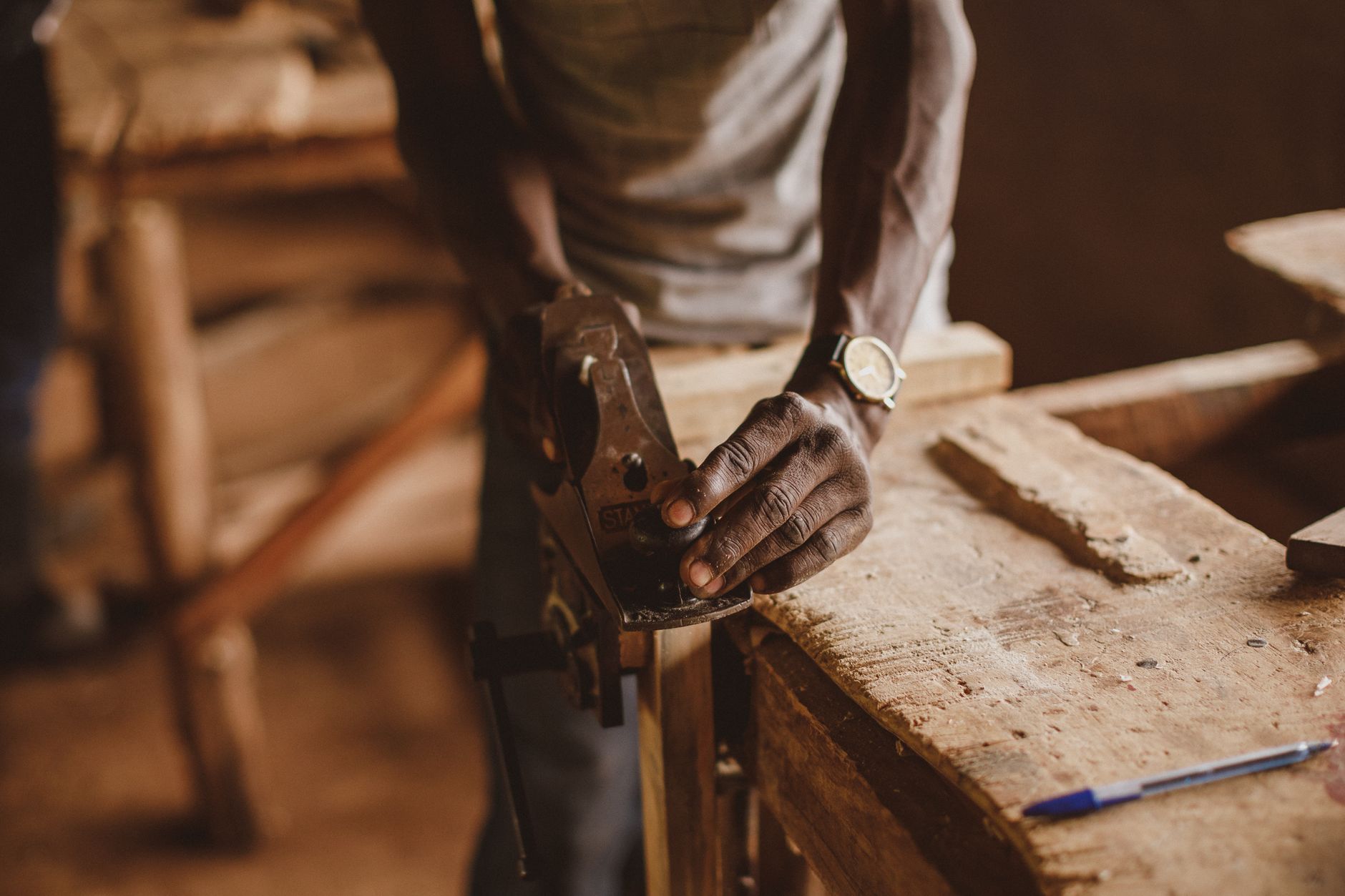
The harvested bark is soaked in water and then beaten repeatedly with a grooved wooden mallet — the grooves are critical, as they direct force evenly while stretching and thinning the fibres laterally without tearing them. The beating process is staged: the bark is worked in sessions over a day or more, folded and refolded, dampened, and beaten again. With each session, the material spreads, thins, and begins to develop the fine, even texture that characterises finished olubugo.
The skill here is not brute force but calibrated repetition. Craftspeople — traditionally men within Buganda Kingdom communities — develop the muscle memory to apply exactly the pressure required. Too little, and the cloth remains thick and rigid; too much, and the fibres tear. The graduated groove patterns on different mallet types are the equivalent of a weaver's tension management: invisible to the outside eye but structurally determining.
Finished bark cloth sheets are sun-dried to a warm, terracotta-brown colour. The natural hue varies from pale ochre in younger inner bark to a rich reddish-brown in older material, and this tonal variation is itself considered an aesthetic quality rather than an inconsistency to be corrected.
Surface and Scale
A single bark sheet can range from a few square feet to several metres, depending on tree size and the craftsperson's technique. Multiple sheets can be joined by beating their edges together while damp — a kind of felting seam that is nearly invisible when executed by a skilled maker. This means bark cloth, unlike most natural textiles, can theoretically be produced in continuous sheets of considerable scale without conventional seaming, a property that contemporary designers have begun to exploit for large-format and sculptural work.
UNESCO Recognition and What It Actually Means for Practice
The bark cloth tradition of the Buganda Kingdom in Uganda holds UNESCO Intangible Cultural Heritage status, inscribed on the Representative List of the Intangible Cultural Heritage of Humanity. This recognition was significant not merely as an honour but as a policy intervention — it formalised international acknowledgement that olubugo represents a living knowledge system transmitted through apprenticeship and family lineage, not a historical technique preserved in museums.
UNESCO's intangible heritage framework is specifically designed for practices like this: skills embedded in communities, dependent on oral transmission, and vulnerable to disruption by economic pressure and cultural marginalisation. For bark cloth specifically, the designation has supported efforts to document production techniques, sustain training, and create market recognition that incentivises younger makers to remain in the craft rather than migrate to urban wage labour.
For designers working with olubugo, the heritage status carries a practical implication: there is a documented, living supply chain rooted in community practice, not an industrial extraction process. That traceability — from named tree grove to named craftsperson — is increasingly the kind of provenance narrative that serious fashion designers and their clients want to understand and communicate.
Material Properties: What Designers Are Actually Working With
Understanding olubugo as a design material requires setting aside assumptions derived from other natural textiles. Its properties are genuinely unusual.
Drape and Hand
Beaten bark cloth has a pliant, slightly felted hand that takes on warmth from the body quickly. In thinner sections, it drapes with a softness approaching fine cotton canvas; in heavier sections, it holds structure in a way that invites comparison to boiled wool or vegetable-tanned leather. This range within a single material — achieved through variation in beating intensity and bark age — gives designers unusual latitude within a single textile.
Breathability and Thermoregulation
Because olubugo is a non-woven bast fibre sheet, it has a microporous structure that allows air movement while providing insulation. In the equatorial climate for which it was originally developed, this made it functional as both ceremonial wrap and everyday garment — a quality that makes it genuinely appropriate for warm-weather fashion rather than a novelty material that performs badly in practice.
Dyeability and Surface Treatment
Bark cloth accepts natural dyes with exceptional fidelity, partly because of its bast fibre composition and partly because of its surface porosity. Historically, the terracotta and deep brown tones were considered complete; contemporary makers and designers have expanded the palette considerably using botanical and mineral dyes. The material also takes printed surface treatments, embossing, and laser cutting — interventions that contemporary designers have explored with considerable results.
Durability and Degradability
Traditional olubugo garments and burial wrappings have survived for considerable periods in archival conditions, demonstrating real durability under appropriate care. The material is also fully biodegradable — a property that has become a design brief as much as a material fact for designers working within circular fashion frameworks.
Historical Context: Ceremonial, Domestic, and Royal Uses
Within the Buganda Kingdom — the largest of the Great Lakes kingdoms and centred in what is now central Uganda — bark cloth was not one textile among many; it was the textile. Its uses spanned the full social spectrum. Royalty were buried in it; ordinary families used it for bedding, clothing, and room partition. It was worn by the Kabaka (king) in important ceremonies and by commoners in daily dress. This range of application — from the most sacred to the most mundane — marks olubugo as structurally central to Buganda material culture in a way that no single textile is to any contemporary industrial society.
The reddish-brown of natural bark cloth became a culturally loaded colour, associated in Buganda with mourning, burial, and the dignity of death. This cultural specificity is worth understanding for any designer working with the material: colour and material here are not aesthetically neutral choices but carriers of meaning that require active engagement rather than casual borrowing.
Contemporary Designers Re-Engineering Bark Cloth
The Design Problem — and Opportunity
Working with olubugo in contemporary fashion is not simply a matter of reaching for an exotic material. The challenges are real: the textile's natural scale limits, its characteristic colour range, its non-woven structure's behaviour under machine sewing, and its relative unfamiliarity to international consumers all require deliberate design thinking rather than substitution for more familiar materials.
Ugandan designers including Sylvia Owori and the label Bark Tex — among others working within and beyond Uganda — have approached these challenges differently, but a few common strategies have emerged in the stronger work: exploiting the material's sculptural potential rather than forcing it into conventional garment construction; treating the surface as a canvas for additional craft layers including embroidery and application; and pairing bark cloth panels with other natural materials — leather, cotton, linen — in ways that allow each material to perform within its strength range.
Construction Adaptations
Machine sewing through olubugo requires needle selection analogous to working with leather — a cutting point rather than a standard sharp, and usually a heavier thread. Seam allowances behave differently than in woven textiles because the non-woven structure does not ravel in the same way, but it can split under stress if seam placement is not considered relative to the fibre direction established during beating. Hand-finishing is common in higher-end work, both for structural integrity and because it aligns with the handcraft origins of the material itself.
Some designers have moved away from conventional garment seaming entirely, using the material's capacity to join seamlessly when beaten together — echoing the original production technique — for zero-seam construction in sculptural pieces.
Surface Innovation
Laser cutting has emerged as a particularly productive technology for bark cloth, producing intricate cutwork that the material holds cleanly due to its non-woven structure. Unlike woven textiles, olubugo does not fray at a cut edge, which means geometric and organic cutwork patterns can be executed at a scale and complexity that would be structurally compromised in most conventional fabrics. Several designers have used this property for large-format screens, installation work, and statement outerwear panels.
Bark Cloth in the Context of African Textile Futures
The renewed interest in olubugo sits within a broader recalibration happening across African fashion — a move away from exoticising "African print" as a monolithic aesthetic (typically meaning Ankara wax print, itself a complex colonial-era history) toward material specificity, regional textile knowledge, and the kind of deep craft engagement that international luxury fashion has always traded on, but rarely credited to African sources.
For the fashion designer with formal training, the argument for bark cloth is not sentimental. It is material. A non-woven bast fibre with a documented production chain, genuine heritage status, biodegradability, dyeability, and structural properties genuinely distinct from anything in the industrial textile market — that is a design brief worth taking seriously. The Mutuba tree has been producing this textile for longer than most of the fibres in any designer's studio have existed as categories. The question the best contemporary work is asking is not whether bark cloth deserves a place in modern fashion, but what modern fashion has to learn from what bark cloth already knows.