To call the agbada a robe is to call a cathedral a building. Technically accurate, structurally insufficient. For designers trained in the grammar of clothing construction, the agbada rewards close reading: it is a garment system engineered across centuries to perform rank, occasion, and identity through the precise management of volume, embroidery placement, and the kinetics of movement. Understanding it means understanding a design tradition as rigorous — and as codified — as any European court dress.
The Ensemble as System: Agbada, Buba, and Sokoto
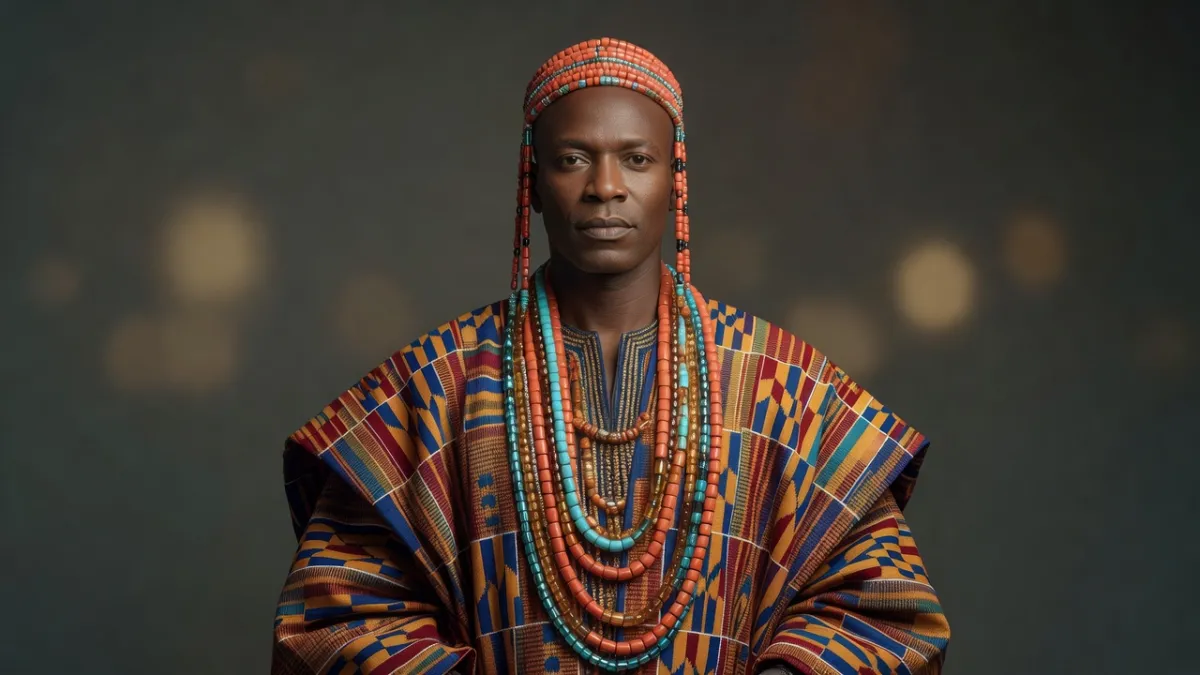
The agbada is a wide-sleeved over-robe worn across West Africa and is one of the three-piece ensemble — agbada, buba, and sokoto — central to formal Yoruba male dress. This matters to designers because the agbada was never conceived as a standalone garment. It operates as the apex layer of a deliberate vertical hierarchy: the sokoto (trousers) anchor the body to the ground; the buba (undershirt) defines the torso's fitted relationship to form; and the agbada suspends above both, a canopy of fabricated authority.
Each layer has its own embroidery register and its own relationship to the body. A designer who treats the agbada in isolation misses the point entirely — its drama is relational, built in contrast to what lies beneath it. The buba's modest decoration makes the agbada's embroidery legible. The sokoto's narrow fit makes the agbada's volume monumental.
As an Amazon Associate, I earn from qualifying purchases.
Volume as Vocabulary
The agbada's most immediately striking feature is its sheer breadth — sleeves that can extend well beyond the hands when the arms are lowered, a body panel that falls to the ankle with enough horizontal spread to dwarf the wearer's silhouette. This is not excess. It is precision.
💼 Career Opportunities
In Yoruba aesthetic philosophy, the concept of àṣà — inherited cultural practice — informs how garments signal social position. Volume in the agbada communicates leisure, authority, and the physical freedom of a man not bound by manual constraint. The wider the sweep, the higher the implied station. Tailors working for Yoruba royalty and chiefs historically calibrated yardage with this social arithmetic in mind. A chief's agbada required significantly more fabric than an ordinary celebrant's — not for warmth or function, but for the visual mathematics of prestige.
The structural challenge this poses is considerable. Unstructured volume of this scale will collapse, bunch, or distort without disciplined cut. Traditional Yoruba tailors solved this through the precise geometry of the over-robe's construction: a near-symmetrical form cut wide enough to drape evenly when the arms are lifted, but balanced enough to hang with controlled stillness when the arms fall. The sleeve-to-body ratio is not arbitrary — it determines whether the garment reads as commanding or merely oversized.
The Embroidery Map: Placement as Rank Indicator
If volume establishes social scale, embroidery specifies its precise coordinates. The placement, density, and technique of embroidery on an agbada constitute a legible code — one that a practiced Yoruba eye reads the way a trained designer reads a technical flat.
As an Amazon Associate, we earn from qualifying purchases.
The Chest Panel: The Highest Register
The primary embroidery field on a formal agbada is the chest panel, known as the aso-oke collar zone or neck placket area. This region receives the most intricate and densest needlework, typically executed in silk or metallic thread. The motifs used here — geometric interlocking patterns, stylized botanical forms, or Arabic-influenced calligraphic borders rooted in the influence of Islamic tailoring traditions across the Sahel — are not decorative in a passive sense. They announce the garment's function before the wearer speaks.
For high-status garments, the embroidery at the chest extends into a cascading bib format, layered so that the density of stitching itself becomes a measure of investment and occasion. This is couture logic by another name: the more laborious the construction, the more serious the social context.
Hem and Sleeve Borders: The Secondary Register
The hem and the sleeve edges carry a secondary tier of embroidery — typically less dense than the chest panel but continuous, framing the garment's perimeter. This border treatment does two things simultaneously: it provides structural reinforcement to edges that experience the most movement stress, and it creates a visual boundary that defines the garment's full spatial extension. When the arms are raised and the agbada spreads to its maximum width, the embroidered borders trace the garment's full architectural footprint in space.
In lower-register occasions or for younger wearers, the border embroidery may be simplified or rendered in a single color matching the ground fabric. The reduction in embroidery complexity directly signals a reduction in formality — a sartorial grammar any designer working in traditional wear would do well to internalize.
Thread, Technique, and Material Hierarchy
The thread hierarchy mirrors the occasion hierarchy. Metallic gold and silver threads — traditionally imported, now produced regionally — are reserved for the highest ceremonial contexts: chieftaincy installations, royal celebrations, high-status weddings. Silk thread in tonal or contrasting colors serves mid-tier occasions. Cotton thread embroidery, while skillfully executed, signals everyday celebration rather than high ceremony.
The embroidery technique most associated with prestige agbada is a form of dense satin-stitch padding that creates a raised, almost sculptural surface — technically demanding because it requires the embroiderer to build up layers of foundation stitching before the surface pattern is laid. The result is embroidery that catches directional light differently as the wearer moves, a characteristic that is not incidental but deeply functional in ritual and ceremonial contexts where the wearer is meant to be seen from a distance.
Motion as Meaning: The Agbada in Performance
Here is where the agbada distinguishes itself most sharply from garments that merely dress the body: it is designed to be performed. The wide sleeves are not worn extended — they are draped, thrown, and gestured with deliberate intention. The act of swinging one or both sleeves over the shoulder is not affectation; it is a formal gesture with encoded social meaning.
Throwing the sleeve over the shoulder signals arrival, authority, and ease simultaneously. It is a movement that requires the full volume of the garment to execute properly — a narrow or poorly cut agbada will not drape over the shoulder with the correct weight and fall. This is why the agbada's construction is inseparable from its performance: the cut must anticipate the gesture. Tailors working in this tradition are, in effect, choreographing the garment as much as constructing it.
In processional contexts — chieftaincy ceremonies, high-profile weddings, festivals — the wearer's gait is also modified by the agbada's volume. A deliberate, measured pace allows the fabric to move in controlled waves rather than chaotic flutter. The agbada teaches its wearer how to walk, in the same way that a trained movement coach teaches an actor to inhabit a period costume. The garment and the body negotiate each other.
Fabric as Social Signal: Aso-Oke and Beyond
The ground fabric of a prestige agbada is most traditionally aso-oke, the hand-woven strip cloth produced on narrow horizontal looms and then joined into widths. Aso-oke carries its own internal hierarchy: ẹlẹṣo (a heavily textured, raised-float weave) sits above plain-weave aso-oke in formal register, and both are distinguished by color — certain colors historically reserved for royalty or specific lineage groups.
Contemporary agbada construction has expanded into brocade, damask, lace-overlaid satin, and even engineered jacquard — fabric choices that shift the garment's social address without abandoning its architectural logic. The volume rules, embroidery placement principles, and gestural grammar remain operative regardless of ground fabric. A designer updating the agbada for contemporary modern African style contexts must understand that the fabric can evolve, but the structural and symbolic logic is load-bearing.
Gender, Evolution, and the Expanding Agbada
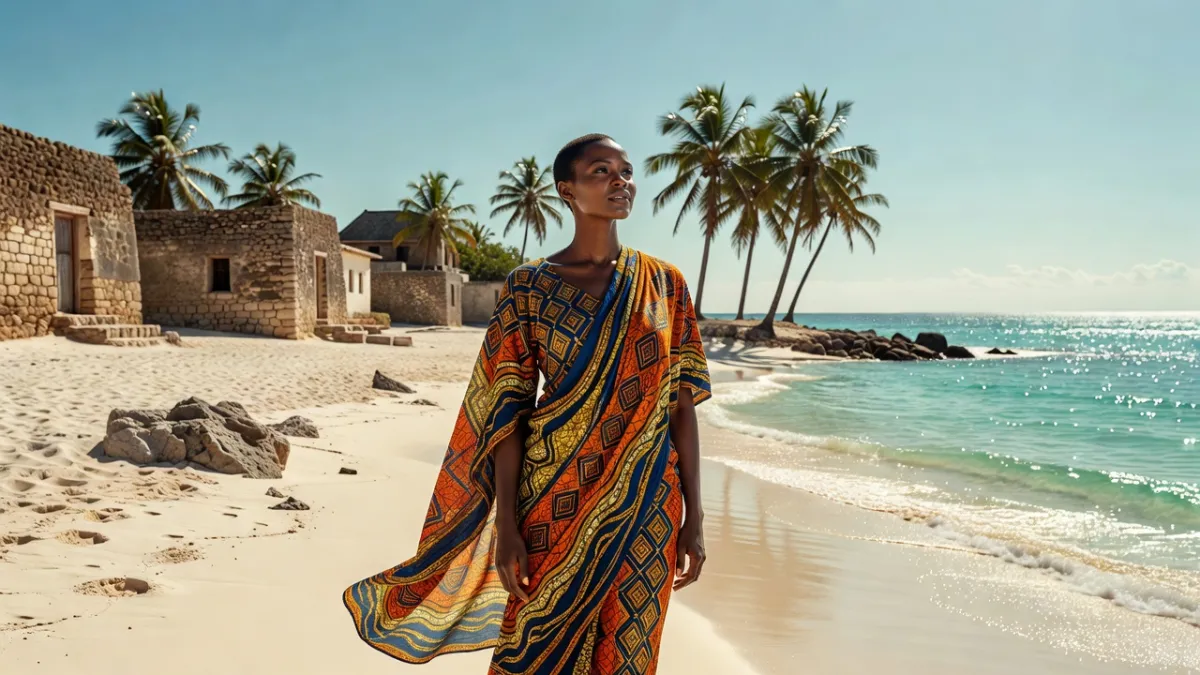
While the agbada's formal codification is rooted in male dress, the garment's form has been adopted and reinterpreted for women's ceremonial wear with increasing sophistication. Women's agbada-inspired silhouettes retain the volume and embroidery hierarchy but negotiate differently with the body — often incorporating a fitted underlayer that the men's buba does not emphasize, and adjusting sleeve drama to suit different movement conventions.
For designers, this gender expansion is technically instructive. It reveals which elements of the agbada are structurally essential (volume proportionality, embroidery placement hierarchy, motion-readiness) versus which are convention-specific (the three-piece male ensemble format). The garment's core architecture, it turns out, is abstract enough to travel across gender presentations without losing its communicative precision.
What Designers Owe This Tradition
The agbada is frequently cited in global fashion discourse as an influence — referenced in runway collections, absorbed into red carpet aesthetics, sampled in diaspora fashion. What is less often acknowledged is the engineering depth behind it. This is a garment that solved the problem of encoding social hierarchy into textile form with the same sophistication that European tailoring used to encode military rank or ecclesiastical authority. Its solutions — the volume calculus, the embroidery placement map, the choreographed gesture — are as considered as any system in the Western canon.
Designers engaging with the agbada, whether in homage, evolution, or dialogue, carry the responsibility of understanding those solutions before departing from them. The shortcuts are visible to anyone who knows the language. The mastery, when present, is unmistakable.
Sources
Every factual claim in this article was independently verified against the following sources:
- Agbada — en.wikipedia.org