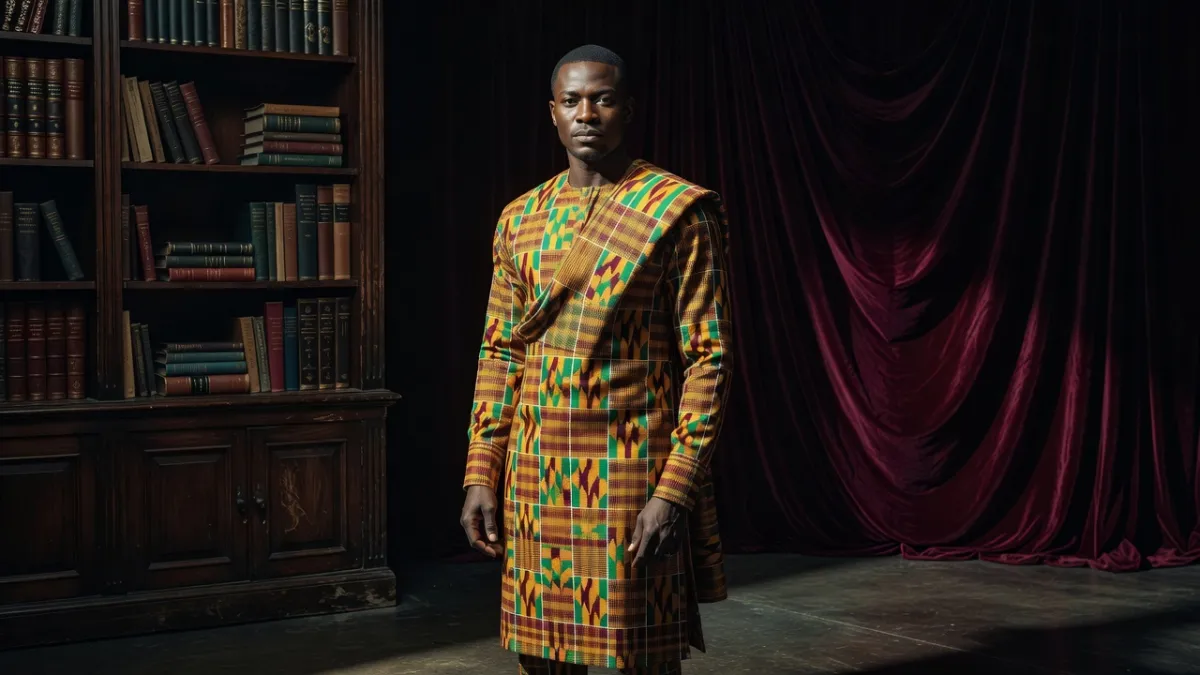
Few objects in the global fashion vocabulary carry as much assumed cultural authenticity as African wax print fabric. The bold geometric repeats, the characteristic crackle lines, the saturated colour fields — to most eyes, Western or African, this cloth reads as unambiguously, ancestrally African. Designers from Duro Olowu to Stella Jean have leaned into that reading. Luxury houses reference it as shorthand for 'Africa.' And yet the material history of African wax print fabric tells a far more complicated story: one routed through colonial Java, mechanised in the Netherlands, and only gradually, genuinely, made African through the accumulation of local meaning.
The Javanese Source: Batik and Its Logic
To understand where wax print comes from, you have to start with what it was trying to copy. The wax-resist printing technique used in African wax print fabric originated in Indonesian batik, which Dutch colonial traders encountered in Java and attempted to mechanically replicate for mass production. Authentic Javanese batik is a painstaking hand-process: molten wax is applied to cloth — traditionally using a tjanting tool or a copper stamp called a tjap — to resist the dye that is subsequently applied. The wax is then removed, and the process may be repeated many times across multiple colours. The result is a textile of genuine complexity, specific to place, and in many cases, to the social rank of the wearer.
Dutch traders in the East Indies had been commercially engaged with Javanese batik for centuries before anyone thought to industrialise it. The fabric commanded real value, and the logic of colonial commerce was straightforward: if something is valuable, find a way to produce it at scale and sell it back to the people who created it — or to someone else entirely.
The Dutch Mechanisation Experiment
The attempt to mechanise batik production began in earnest in the nineteenth century. The challenge was reproducing the wax-resist effect — including its characteristic irregular crackle, caused when wax fractures slightly during dyeing and allows colour to seep into the cracks — through an industrial rotary printing process rather than by hand. Early machines could approximate the pattern but struggled to replicate the spontaneous imperfection that gave hand batik its character.
The solution was counterintuitive: rather than eliminate the crackle, manufacturers standardised it. The crackle became a deliberate aesthetic feature of the machine-made cloth — what we now recognise as the marbling or vein-like quality visible in wax print today. It is, in a technical sense, an industrial simulation of a handcraft defect, elevated into a design signature.
Dutch company Vlisco, founded in Helmond, Netherlands, has been producing wax print fabric marketed to West African consumers since the 1840s and remains one of the dominant manufacturers of the cloth today. Vlisco's founding role is significant: this was not an opportunistic pivot but a core commercial strategy from an early stage. The company's archives contain pattern books running to thousands of designs developed specifically for West African taste preferences over more than a century and a half — a rich design history that is Dutch in manufacture and African in creative brief.
The West African Market and the Failure in Java
The original target market for machine-made batik was, in fact, the Indonesian consumer — Dutch manufacturers hoped to undercut Javanese handcraft producers with cheaper mechanised goods. The strategy largely failed. Javanese buyers remained attached to the genuine article, distinguishing machine prints from hand batik with little difficulty and assigning them lower social value. The industrial product was rejected at the source.
West Africa, however, was a different commercial proposition. Dutch and British trading companies operating along the Gold Coast and in the Niger Delta found that wax print cloth, with its vivid palette and graphic scale, was enthusiastically received. Merchants — many of them Ghanaian, Nigerian, and Togolese traders who quickly understood the commercial opportunity — became the primary distribution network. The cloth moved inland through existing trade routes, and within a generation, it had become not just accepted but genuinely desired.
It is worth being precise about what this means: the West African market did not simply absorb a foreign product passively. It actively shaped the product through demand. When particular colours, scales, or motifs sold better than others, manufacturers adjusted. The design feedback loop ran from Accra and Lagos back to Helmond, making the cloth a collaborative object even as the production remained in Europe.
The Encoding of Meaning: When Import Becomes Culture
The most intellectually significant aspect of wax print history is what happened to the fabric once it was embedded in West African social life. Different wax print patterns acquired specific local names and social meanings across West Africa — for example, patterns were named after proverbs, political events, or social situations — giving the imported fabric genuine indigenous cultural encoding.
This naming practice transformed the object's cultural status entirely. A pattern that a Dutch designer in Helmond conceived as a geometric repeat became, in the Ghanaian market, 'My husband's money is mine too' or 'The jealous one.' In Côte d'Ivoire, specific patterns were associated with particular life events — courtship, mourning, political allegiance. Women became fluent readers of pattern as social text, able to communicate through cloth in ways that were entirely opaque to the fabric's manufacturers. The medium was European; the message was local.
This encoding process is not metaphorical cultural appropriation — it is a genuine act of cultural production. The people wearing and naming these fabrics were not passively receiving a foreign object; they were inscribing it with a meaning system that the original producers neither created nor controlled. The argument that wax print is 'not authentically African' because of its industrial Dutch origins misunderstands how cultural objects actually work. Authenticity is not a property of manufacture; it is a property of use, meaning, and community investment over time.
Post-Independence Production and the Politics of Origin
The decolonisation era introduced new complexity. As West African nations achieved independence in the late 1950s and 1960s, the idea of wearing cloth that was manufactured in the Netherlands sat uneasily alongside developing nationalist identities. This created both political tension and commercial opportunity. African manufacturers — in Ghana, Nigeria, and Côte d'Ivoire in particular — began producing their own wax prints, often using licensed Dutch designs or developing original patterns. Later, Chinese manufacturers entered the market at significantly lower price points, producing vast quantities of wax-print-style cloth for export to Africa.
The result is a contemporary market stratified by production origin in ways that roughly mirror social stratification among consumers. Vlisco cloth retains prestige status in several West African markets, partly because its long history in the region has made it a known quantity and partly because of active brand management. Ghanaian-produced prints occupy a middle tier. Chinese-made imitations — often visually similar but printed using different techniques — occupy the mass market. The ability to read these distinctions is itself a form of textile literacy, significant in gift-giving, ceremonial dress, and expressions of economic status.
Implications for Designers Working with Wax Print
For fashion design professionals engaging with this fabric, the history matters practically, not just theoretically. A few considerations are worth holding in mind.
Pattern Ownership Is Not Straightforward
The pattern archives held by Vlisco and other European manufacturers represent a large portion of the canonical wax print vocabulary. When designers use 'traditional' wax print patterns, they are often drawing on designs that are legally the intellectual property of Dutch companies. This is an uncomfortable fact that the fashion industry has been slow to address directly.
The Naming Layer Is Culturally Specific
The social meaning encoded into patterns through naming is geographically and linguistically specific. A pattern that carries a particular connotation in Accra may mean something entirely different in Lagos or Abidjan, or nothing at all outside its home context. Designers using these fabrics in international contexts should be cautious about claiming specific cultural meanings they cannot accurately place or verify.
The Crackle Is Diagnostic
From a technical standpoint, the resin crackle visible on authentic wax print (as distinct from roller-printed imitations that merely simulate the aesthetic) is produced by a genuine wax-resist or resin-resist process. The crackle appears on both the face and back of the fabric with similar intensity — one useful indicator of genuine wax print construction versus a screen-printed approximation.
Context of Use Transforms Meaning
The deeper lesson of wax print history is that the design origin of a textile is not the end of its cultural story. African wax print fabric is genuinely, meaningfully African — not despite its Dutch-Indonesian origins but alongside them. The object has been so thoroughly worked over by generations of West African wearers, traders, naming practices, and ceremonies that any claim that it is 'not really African' is historically shallow. The fabric is a living example of how global material culture actually moves: not in clean lines of influence but in circuits of production, adaptation, and re-inscription that make origin questions permanently tangled.
For designers, that complexity is not a liability. It is precisely what makes the fabric rich enough to have generated this much meaning in the first place.
Sources
Every factual claim in this article was independently verified against the following sources:
- Vlisco - Wikipedia — en.wikipedia.org
- African wax prints - Wikipedia — en.wikipedia.org
- r/Africa on Reddit: The Wax Hollandais: The Crazy and Funny History of a Non-African Fabric — reddit.com